
What Is Computer Integrated Manufacturing (CIM)? A Complete Guide for Modern Businesses
Introduction
Computer Integrated Manufacturing (CIM) is a modern manufacturing approach that uses computers, automation systems, and digital technologies to control and manage the entire production process. From product design and planning to manufacturing and quality control, CIM connects every stage of production through a centralized computer system.
As industries continue to embrace Industry 4.0, Artificial Intelligence (AI), and smart manufacturing technologies, Computer Integrated Manufacturing has become a critical component of efficient and competitive production environments. Businesses use CIM to improve productivity, reduce costs, minimize errors, and enhance product quality.
This comprehensive guide explains everything business professionals need to know about Computer Integrated Manufacturing, including its components, benefits, applications, challenges, and future trends.
What Is Computer Integrated Manufacturing?
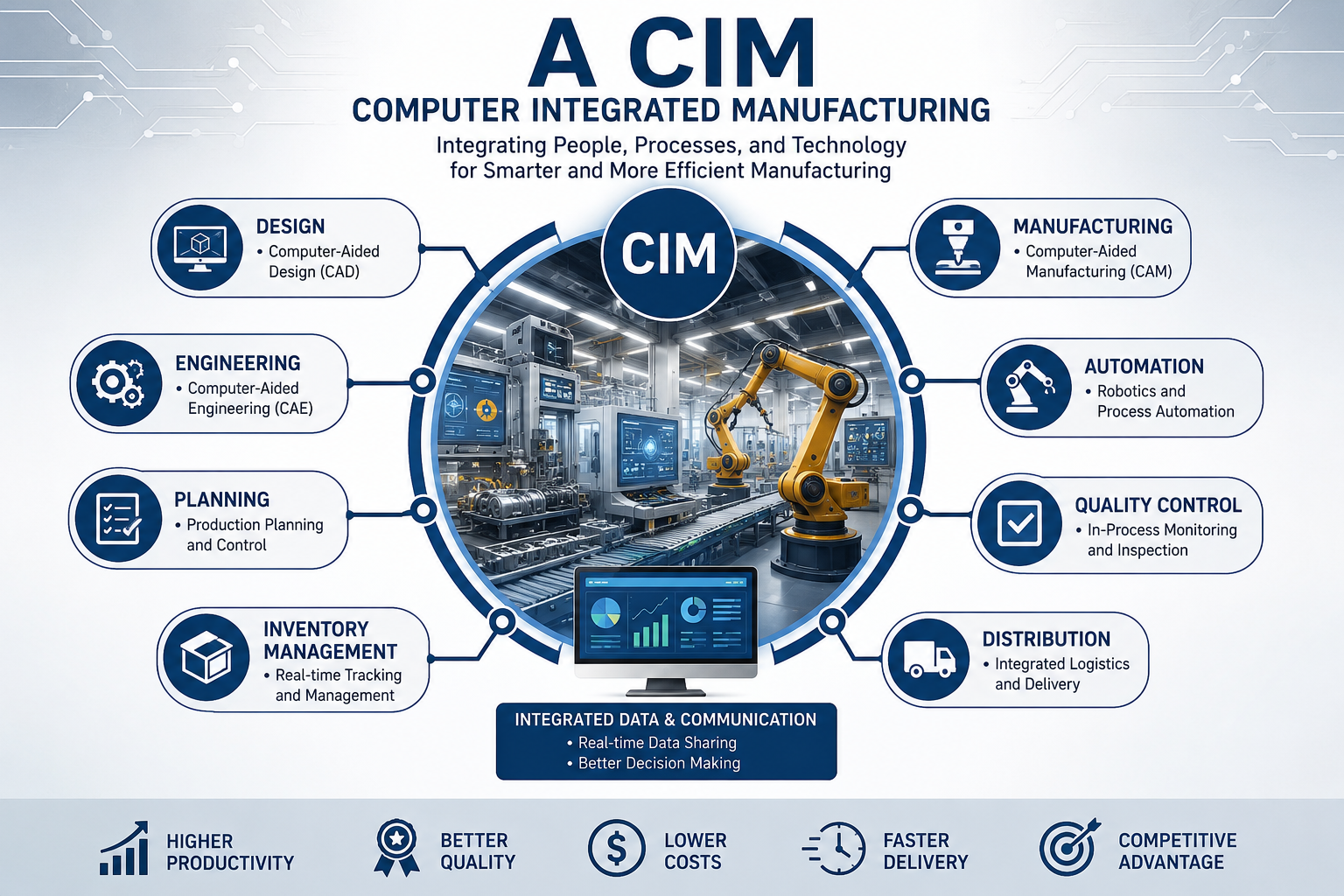
Computer Integrated Manufacturing (CIM) refers to the use of computer systems to control the entire manufacturing process. It integrates various production activities such as design, engineering, manufacturing, inventory management, quality control, and distribution into a unified digital system.
The primary objective of CIM is to automate manufacturing operations while ensuring seamless communication between different departments and machines.
Instead of operating as separate functions, all manufacturing processes work together through interconnected computer systems, creating a highly efficient and automated production environment.
Simple Definition
Computer Integrated Manufacturing is a manufacturing method where computers coordinate, monitor, and control all stages of production to improve efficiency, accuracy, and productivity.
History of Computer Integrated Manufacturing
The concept of Computer Integrated Manufacturing emerged during the 1970s and 1980s as manufacturers sought ways to automate production processes.
Initially, companies used standalone computer systems for specific tasks such as:
- Computer-Aided Design (CAD)
- Computer-Aided Manufacturing (CAM)
- Production scheduling
- Inventory management
Over time, businesses realized the value of integrating these systems into a single manufacturing network.
The development of:
- Industrial robotics
- Enterprise Resource Planning (ERP)
- Artificial Intelligence
- Internet of Things (IoT)
- Cloud computing
has transformed CIM into a sophisticated manufacturing framework capable of supporting smart factories and digital transformation initiatives.
How Computer Integrated Manufacturing Works
Computer Integrated Manufacturing works by connecting different manufacturing functions through a centralized information system.
The process generally includes:
1. Product Design
Engineers create digital product models using CAD software.
2. Engineering Analysis
Computer systems evaluate designs for performance, strength, and manufacturability.
3. Production Planning
Manufacturing schedules, workflows, and resource allocation are automatically generated.
4. Manufacturing Execution
Machines, robots, and automated systems produce products based on digital instructions.
5. Quality Control
Sensors and inspection systems monitor product quality in real time.
6. Inventory Management
Computer systems track materials and finished products throughout the supply chain.
7. Distribution
Orders and logistics are coordinated through integrated software platforms.
By linking these activities together, CIM creates a seamless manufacturing ecosystem.
Key Components of Computer Integrated Manufacturing
Several technologies work together to create a successful CIM environment.
Computer-Aided Design (CAD)
CAD software enables engineers to create precise digital models and technical drawings.
Benefits include:
- Faster product development
- Improved design accuracy
- Easier modifications
- Better collaboration
Popular CAD software includes AutoCAD, SolidWorks, and CATIA.
Computer-Aided Manufacturing (CAM)
CAM converts digital designs into machine instructions.
CAM systems help manufacturers:
- Automate machining processes
- Improve production speed
- Reduce waste
- Enhance consistency
Computer Numerical Control (CNC)
CNC machines use computerized controls to operate manufacturing equipment.
Examples include:
- CNC milling machines
- CNC lathes
- CNC laser cutters
- CNC routers
These machines produce highly accurate components with minimal human intervention.
Robotics and Automation
Industrial robots play a major role in CIM environments.
Robots perform tasks such as:
- Welding
- Assembly
- Packaging
- Painting
- Material handling
Automation increases production speed and consistency.
Manufacturing Execution Systems (MES)
MES software monitors and controls manufacturing operations in real time.
Functions include:
- Production tracking
- Resource management
- Performance monitoring
- Quality management
Enterprise Resource Planning (ERP)
ERP systems integrate manufacturing with business functions.
Key areas include:
- Finance
- Procurement
- Human resources
- Inventory management
- Customer service
ERP helps organizations make data-driven decisions.
Objectives of Computer Integrated Manufacturing
The primary goals of CIM include:
Increased Productivity
Automation allows manufacturers to produce more products in less time.
Improved Quality
Computerized systems reduce human errors and maintain consistent quality standards.
Reduced Manufacturing Costs
CIM minimizes waste, rework, and operational inefficiencies.
Faster Production Cycles
Integrated systems streamline workflows and reduce delays.
Better Resource Utilization
Manufacturers can optimize labor, equipment, and materials.
Enhanced Flexibility
CIM enables quick adaptation to changing customer requirements.
Advantages of Computer Integrated Manufacturing
Organizations adopting CIM enjoy numerous benefits.
Higher Efficiency
Automated processes reduce manual work and increase operational efficiency.
Better Product Quality
Computer-controlled systems ensure consistent manufacturing standards.
Reduced Production Costs
Lower labor requirements and fewer errors lead to significant cost savings.
Faster Time-to-Market
Products can move from design to production more quickly.
Improved Data Management
Real-time data supports informed decision-making.
Increased Customer Satisfaction
High-quality products and shorter delivery times improve customer experiences.
Greater Competitive Advantage
Manufacturers can respond faster to market demands and outperform competitors.
Applications of Computer Integrated Manufacturing
Computer Integrated Manufacturing is used across various industries.
Automotive Industry
Car manufacturers use CIM for:
- Vehicle assembly
- Welding operations
- Quality inspections
- Supply chain management
Leading automotive companies rely heavily on robotics and automation.
Aerospace Industry
Aircraft manufacturers use CIM to produce highly precise components.
Applications include:
- Engine manufacturing
- Structural assembly
- Safety testing
- Maintenance planning
Electronics Manufacturing
Electronics companies use CIM to manufacture:
- Smartphones
- Computers
- Semiconductors
- Consumer electronics
Precision and quality control are essential in this sector.
Medical Device Manufacturing
Medical equipment manufacturers use CIM to produce:
- Surgical instruments
- Diagnostic devices
- Prosthetics
- Medical implants
Strict quality standards make automation highly valuable.
Consumer Goods Production
Manufacturers of household products use CIM for:
- Packaging
- Labeling
- Product assembly
- Inventory management
Challenges of Computer Integrated Manufacturing
Despite its benefits, CIM also presents challenges.
High Initial Investment
Implementing CIM requires significant spending on:
- Hardware
- Software
- Robotics
- Infrastructure
Small businesses may find adoption expensive.
Complex System Integration
Connecting multiple technologies can be difficult.
Manufacturers must ensure compatibility between:
- ERP systems
- MES platforms
- Robotics
- Production equipment
Employee Training Requirements
Workers need specialized skills to operate and maintain CIM systems.
Training programs are essential for successful implementation.
Cybersecurity Risks
Connected manufacturing environments are vulnerable to cyber threats.
Companies must invest in:
- Network security
- Data protection
- Access controls
- Threat monitoring
Maintenance Costs
Advanced manufacturing technologies require regular maintenance and updates.
CIM and Industry 4.0
Computer Integrated Manufacturing serves as a foundation for Industry 4.0.
Industry 4.0 introduces technologies such as:
- Artificial Intelligence (AI)
- Internet of Things (IoT)
- Big Data Analytics
- Cloud Computing
- Digital Twins
These technologies enhance CIM capabilities and enable smart manufacturing.
Smart factories can collect, analyze, and act on real-time data to improve operational performance continuously.
Role of Artificial Intelligence in CIM
Artificial Intelligence is transforming Computer Integrated Manufacturing.
AI helps manufacturers:
Predict Equipment Failures
Predictive maintenance reduces downtime and repair costs.
Optimize Production Scheduling
AI algorithms improve resource allocation and workflow management.
Improve Quality Control
Machine vision systems detect defects with exceptional accuracy.
Enhance Supply Chain Operations
AI forecasts demand and optimizes inventory levels.
The integration of AI with CIM creates highly intelligent manufacturing systems.
Future Trends in Computer Integrated Manufacturing
The future of CIM is driven by technological innovation.
Smart Factories
Manufacturing facilities will become increasingly autonomous.
Digital Twins
Virtual models will simulate production environments and improve decision-making.
Collaborative Robots
Cobots will work safely alongside human employees.
Cloud Manufacturing
Cloud-based platforms will enhance scalability and remote management.
Sustainable Manufacturing
CIM systems will help organizations reduce waste and energy consumption.
AI-Powered Automation
Artificial Intelligence will continue improving manufacturing efficiency and flexibility.
Best Practices for Implementing CIM
Businesses considering CIM should follow these recommendations:
Define Clear Objectives
Establish measurable goals before implementation.
Invest in Employee Training
Ensure workers understand new technologies and processes.
Choose Scalable Solutions
Select systems that can grow with the business.
Focus on Data Integration
Ensure seamless communication between all manufacturing systems.
Prioritize Cybersecurity
Protect sensitive manufacturing data and infrastructure.
Monitor Performance Metrics
Track productivity, quality, and operational efficiency regularly.
Why CIM Matters for Business Professionals
Business leaders must understand Computer Integrated Manufacturing because it directly impacts:
- Profitability
- Productivity
- Product quality
- Customer satisfaction
- Market competitiveness
Companies that embrace digital manufacturing technologies gain significant advantages in today’s rapidly evolving industrial landscape.
For decision-makers, CIM provides valuable insights into production operations while supporting strategic growth initiatives.
Conclusion
Computer Integrated Manufacturing (CIM) is a powerful manufacturing strategy that integrates computers, automation, software, and machinery into a unified production system. By connecting design, engineering, manufacturing, quality control, and business operations, CIM enables organizations to improve efficiency, reduce costs, and deliver higher-quality products.
As Industry 4.0 technologies continue to evolve, CIM will remain a cornerstone of modern manufacturing. Businesses that invest in integrated manufacturing systems position themselves for long-term success, innovation, and competitiveness in the global marketplace.
Whether you’re a manufacturing executive, operations manager, engineer, or business professional, understanding Computer Integrated Manufacturing is essential for navigating the future of industrial production and digital transformation.
 what-is-computer-integrated-manufacturing-cim